Anglers News« Back to 2026 News |
Over decades in Chatham, Ed Baird has built an unparalleled legacy with the A’s
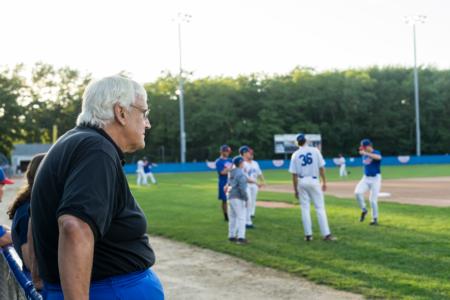
CHATHAM, Mass. — The maestro of Chatham’s merchandise operation sits behind a cash register and many, many new t-shirts, sweatshirts and hats, the same way he has for many, many years. He’s back at Veterans Field for another summer in paradise. The last one brought the plaid grey pajama pants he’s sporting as he rings customers up. This current one brought the plaid red pajama pants on the table he’s sitting behind. There’s no telling what the next will bring.
“I like the selection this year,” a fan tells him.
“Good,” he says as he rings the man up for his shirt. “That’s what we like to hear.”
It’s June 16, Chatham’s second home game, and Ed Baird is back in the swing of things. This merchandise booth is finely tuned, supported by an ensemble of volunteers. Several of them are teenagers, just like Ed was when he first came to Chatham in 1965. He’s glad to be back.
“If it wasn't for the feelings that I have from having played here, and the friendships that I've developed over the years in the town itself,” Ed said, “I probably wouldn't have done this for as long as I'm doing it.”
But Chatham is home. That’s why “Big Ed” keeps making the annual pilgrimage from his residence in Connecticut to Veterans Field, conducting its merchandise booth with the same dominion he — as a Cape League Hall of Fame pitcher — once held over its mound. Things change on the Cape, more than they used to. Players come and go much faster than they used to, especially compared to the 1960s, when Ed was one of several returning players on 1967’s championship team.
And Ed’s still here, a bridge between two eras, as if nothing’s ever changed at all.
“Big Ed is the face of the organization,” Chatham Athletic Association president Steve West said June 27, in a speech addressing the organization at its annual Chatham Bars Inn luncheon.
“He really is Mr. Angler.”
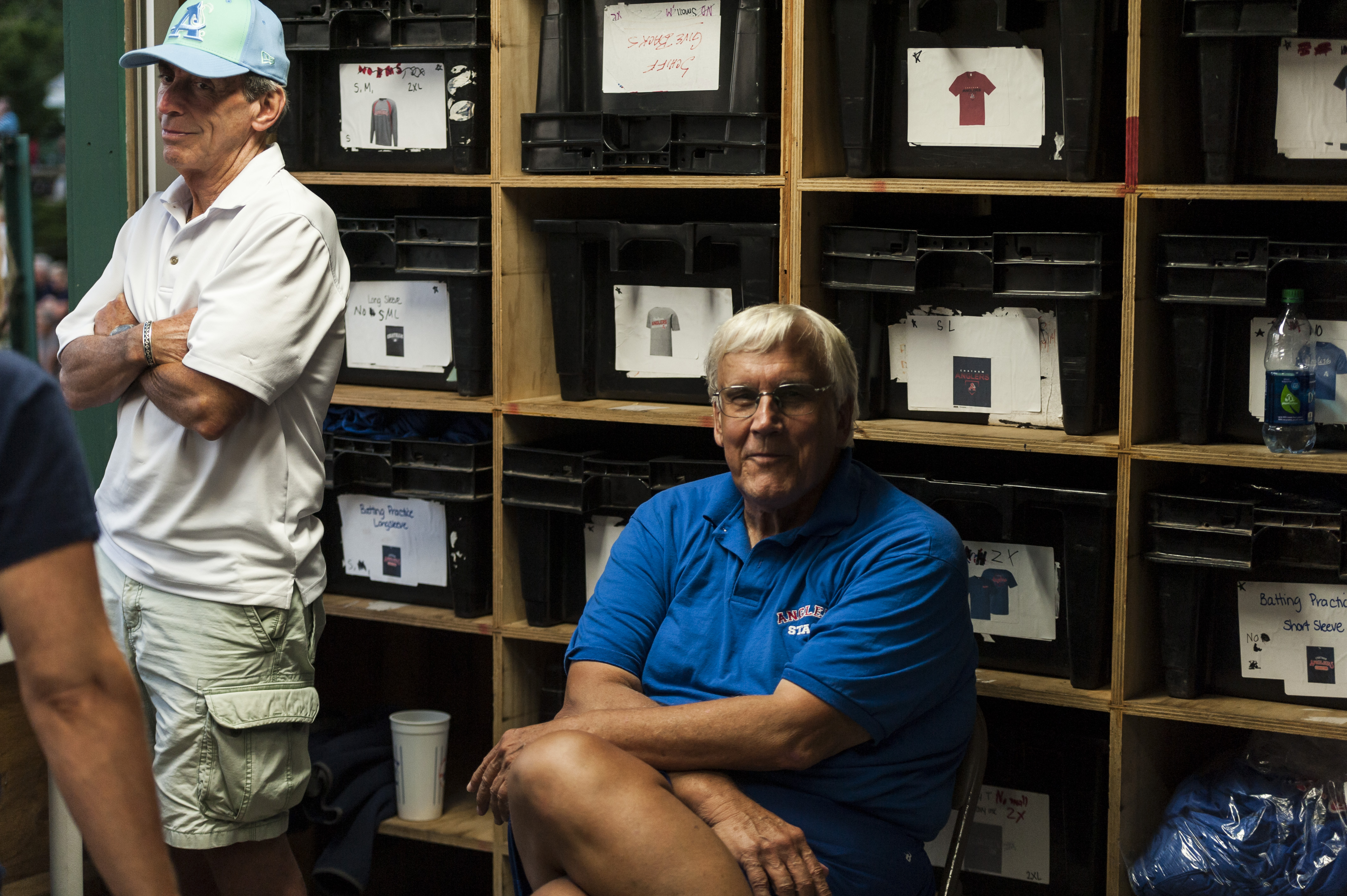
Ed Baird, donning a blue Anglers' polo, sits behind rows of clothes in black boxes during a 2018 game at Veterans Field. Baird has been the A's treasurer and merchandise coordinator for over a decade. Photograph by Julia Hopkins
The Veterans Field press box sits behind rows of aluminum bleachers. The paint adorning its wooden 22-year-old exterior is a rich pine green. Four white disks resembling baseballs are bolted on the front of it. Each holds a name and a retired number. Three of them belong to longtime A’s coaches. Only one belongs to a player, and it reads:
19
Circling the number, in smaller blue print:
ED BAIRD
Each walk up the staircase inside the press box takes the same toll. The creak of wooden steps set the rhythm of one’s ascent. The light blue paint on each landing has been worn down by two decades of visits. Stories are told in this box, and these stairs tell a story themselves. This path has been laid out by all who came before.
Ed’s Chatham legacy can be split into two eras. The first is documented inside a black box atop this staircase. It holds a spiral-bound notebook, well over 100 pages thick, with each of the Cape Cod Times’ articles from the summer of 1967 — Chatham’s first championship season.
“That's the way it was back then,” Ed said. “The paper was full of stories about every Cape League game from the day before."
The parents of Gary Lautzenhiser, Chatham’s first baseman in 1967, preserved all of the Times’ newspapers from that summer. Ahead of the team’s 2005 reunion, Lautzenhiser sent them to Ed, who photocopied the stories into this yearbook commemorating their season. Ed says it's a priceless recap of that championship summer.
In its totality, the book is a physical record of Ed’s dominance. “Chatham Wins, 7-0, On Baird’s 2-Hitter,” reads a headline from June 28, 1967. “Baird Pitches One-Hitter In Darkness-Halted Tilt,” says another clipping from July 14. “Ed Baird Shuts Out Cardinals for 1-0 Lead,” reads a third story from August 27, a playoff game against Orleans.
And that’s how Ed concluded his dominant three-summer run in Chatham, leaving the Cape with a 1.89 earned run average. It took him some convincing to even get there. George Greer — who played with Ed at UConn — called him at least four times trying to get him to join the A’s, and Ed’s own hesitation due to a knee injury sustained during his freshman year at UConn, was the only force that could stop him.
“You have to talk Ed into doing something, and you can't take no for an answer,” Greer said. “And once he does it, then he loves it.”
He loved a lot of things, comedy being one of them. Ed often told self-deprecating jokes, most of which have been lost to the sands of time. He hated running, so when Chatham manager Joe “Skip” Lewis had pitchers run sprints, Ed made guys laugh by sticking his head under a hose to make it look like sweat. Lewis asked him if he did his sprints, to which Ed said yes.
“If you did any running at all,” Lewis once replied, “then I'm a Japanese aviator.”
But Ed wasn’t nearly as funny on the mound. “He was an imposing figure,” said Bobby Valentine, the former New York Mets manager who played for Yarmouth in 1967. There’s a portion of Valentine’s memoir, “Valentine’s Way: My Adventurous Life and Times,” where he recalls a matchup against Ed. He stood close to the plate as Ed warmed up, trying to time his rhythm, while A’s catcher Thurman Munson tried to warn him against it.
“Thurman told me not to do that,” Valentine recalled in a recent phone interview. “It probably wasn't good for my future.”
It wasn’t because Valentine was a high schooler at the time. With how hard Ed was throwing, it just wouldn’t have been a good idea for any hitter’s future, frankly.
In that 1967 season, he pitched four shutouts en route to Chatham's championship. He led the Cape with 70 strikeouts the summer before that, and held batters to just 4.05 hits per nine innings in 1965. Ed never won the BFC Whitehouse Pitcher of the Year Award — it twice went to his teammate, Joe Jabar — but Jabar still believes they should’ve shared it.
Yet many fans who visit Veterans Field may never make the connection between the retired number adorning one side of the press box, and the man sitting around the corner who wore it.
“You wouldn't know that he was a storied pitcher for UConn in his youth. Or had three terrific seasons in Chatham, and he was arguably the best pitcher in the league when he played here,” Anglers general manager Mike Geylin said. “Things like that, you would never get that from Ed.”
He’s modest and doesn’t feel the need to harp on his playing career, because that was all a past life. Ed leads a different one now, as does everyone from those years. Greer served as Wake Forest’s head coach for almost two decades. Jabar went to law school at the University of Maine, and became a justice in the Maine Supreme Court.
But there’s something special about Chatham. It exerts a magnetism on those who visit. Year after year, the same people come back at the same times, doing the same things all over again. “The Chatham Experience,” as former A’s manager John Schiffner calls it.
Before the team’s 2005 reunion, Ed penned a preface for his yearbook. It ends with a message to his teammates:
“I am anxiously awaiting the weekend of July 23, 2005, when most of us will return to Veterans Field to celebrate and get reacquainted,” it reads. “However, this year, when we all once again go our separate ways, let's make sure we find the time to stay connected.”
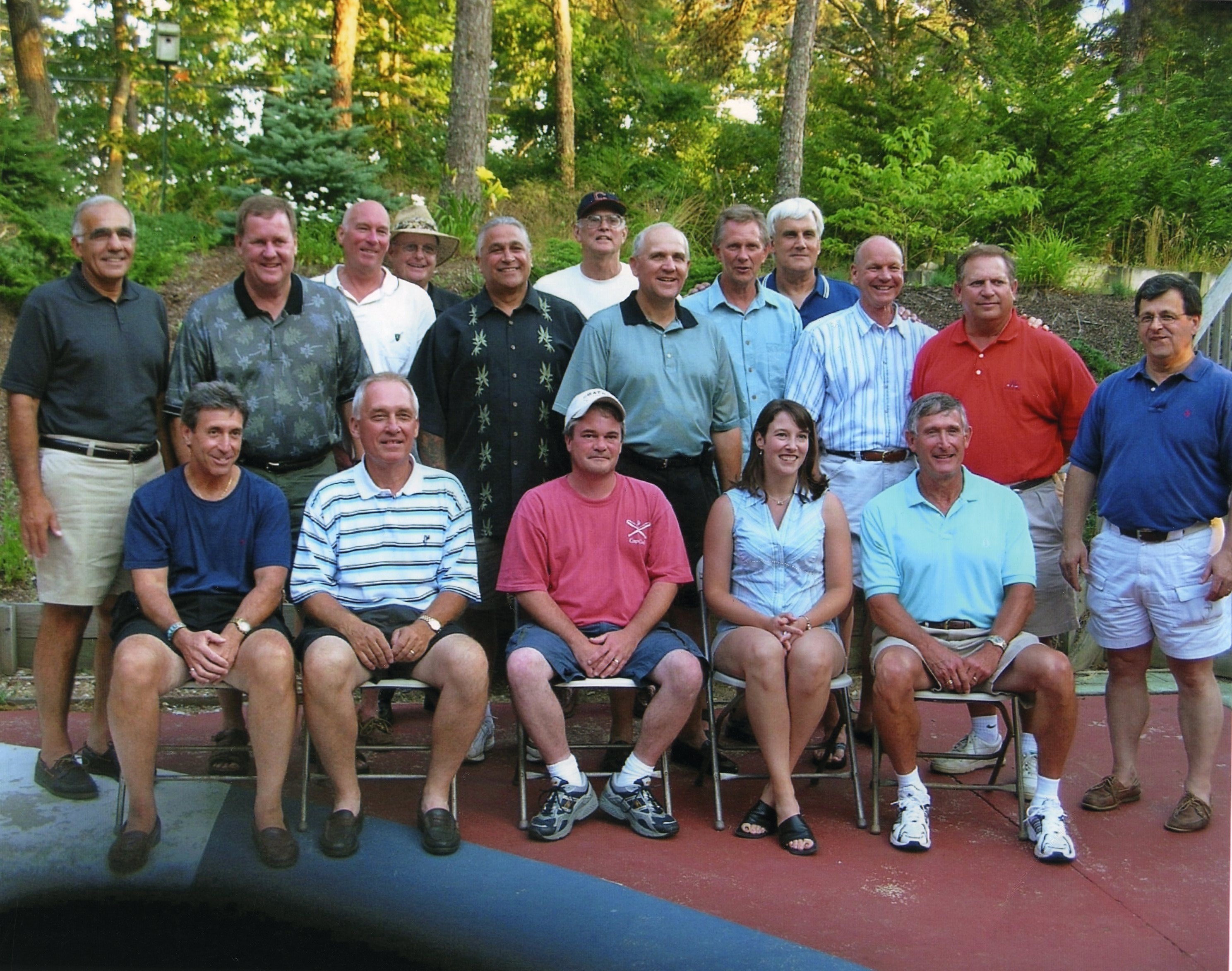
The members of Chatham's 1967 championship-winning team pose for a team photo during their reunion in July 2005. Baird helped organize the reunion with the help of his teammates. Chatham Anglers File Photo
The second era of Ed’s time in Chatham lies directly below that spiral-bound book. One important chapter of his life was written at Veterans Field, and this one is, too. There were a couple years of pro ball and a couple decades of accounting between the two, but Ed can’t stay away. It’s been that way forever.
“Back then, when the season was over, we didn't want to go home,” Ed said. “Chatham is a great place to spend time.”
It’s why the vast majority of his summers are spent here, manning this register in the merchandise booth directly below the Veterans Field press box. This is the branding boom that he and Debbie Kavey bolstered. Geylin couldn’t even fathom the financial benefits the CAA, a non-profit organization, has reaped from this operation.
“I know the numbers of what we sell in five hours, four-and-a-half hours,” Geylin said. “I also know that no store in town is doing that.”
Years before Ed arrived, merchandise was run by Diane Troy, the wife of former Chatham Athletic Association president Peter Troy. Back then, West says, it was a “very well-run operation.”
But after the Troys moved on, the organization experienced a period of instability. The CAA went through “two or three presidents,” per West, and merchandise sales stagnated.
“Having a stable dynamic has been very, very helpful,” West said. “But that was not the organization that Ed and I entered.”
Years before, Schiffner met Ed at a UConn football tailgate hosted by Greer. The two hit it off. So well, in fact, that at some point in the early 2000s, Ed began visiting the Cape in the summers. He stayed at Schiffner’s Harwich residence whenever he came to town.
That routine continued for years. In 2011, the CAA was looking for a treasurer. Schiffner, knowing Ed’s accounting background and love for Chatham made him a perfect fit, asked if he wanted to take the role. Ed didn’t think it made sense for the team treasurer not to live in Chatham, but Schiffner offered up his home for him.
Ed relented and initially became interim treasurer. Shortly after, the CAA asked if he was willing to run merchandise as well. He didn’t have a modicum of merchandising experience, but they said there was a woman who could help him. She’d done similar stuff for her son’s youth hockey team.
Her name was Debbie Kavey.
From there, a partnership was born. Their responsibilities weren’t set in stone, but certain things were always delegated certain ways. Debbie dealt with vendors in Massachusetts, Ed handled those in Westchester, New York. Ed loved hats and athletic gear, while Debbie loved more beachy, relaxed designs — what they called “resort wear.”
“It could be found downtown, it could be found at the baseball game, but it says Chatham Anglers,” her son, Jack, said. “She loved those designs.”
The bond between Ed and Debbie soon became a familial one — “You are part of our family,” her sister, Kathy Olsen, would tell him — so naturally, the booth became a family affair. Jack soon followed in his mother’s footsteps, first by folding clothes as a child, then by showing up to merchandise meetings at 15, and then by coming up with designs for clothes.
Ideas came from everywhere. Ed searched athletic websites and watched sports year-round, and jotted down ideas he liked from the designs he saw on the internet and TV. Jack, who eventually attended Providence College, drew inspiration from what he saw his peers wearing on campus or downtown. Debbie would take pictures of everything, from Vineyard Vines shirts to college bookstore apparel.
It was a well-oiled machine, right up until the winter before the COVID-19 pandemic, when Debbie lost her bout with esophageal cancer.
“He and I were (going to) lunch, and he called me up,” Anglers’ public address announcer Peter Burns recalled. “And he said, ‘I know you think I'm calling you for lunch, but Debbie passed away.’”
Jack was crushed. “There was definitely a part of me that was like, ‘Oh, I don't wanna be at that field,’” Jack says, but he eventually reframed the role. The booth wasn’t a reminder of his mother’s passing, but a chance to continue her legacy.
That’s how Debbie’s other sister, Joan Streeter, viewed it, too. Streeter knew she couldn’t fill Debbie’s shoes. Debbie was so integral to the operation that Ed nicknamed her “Mama Merch.” But Streeter felt she owed it to her sister’s legacy to try to keep it going.
“Debbie and Ed had built such a fantastic stand,” Streeter said. “I just wanted to be part of it.”
Thus, the booth looks both different and the same now. Jack’s not around anymore, having graduated from Providence, and his brother R.J. has taken his place, folding new shirts and putting them into old black boxes. Streeter’s here in her sister’s place, but Debbie’s stamp is still left in the booth’s three-table U-shaped formation, which she created herself.
And Ed is still parked at the register. His products are still flying off the shelves.
Every year, Geylin says, the board members joke amongst themselves if this is the year that the proverbial bubble bursts, and their merchandise sales drop back down to earth. Every year, without fail, the answer is an emphatic no. It’ll remain that way as long as Ed’s there.
“This is Chatham,” Ed jokes, sitting at his register. “People enjoy our merchandise, and don't think twice about spending year after year.”
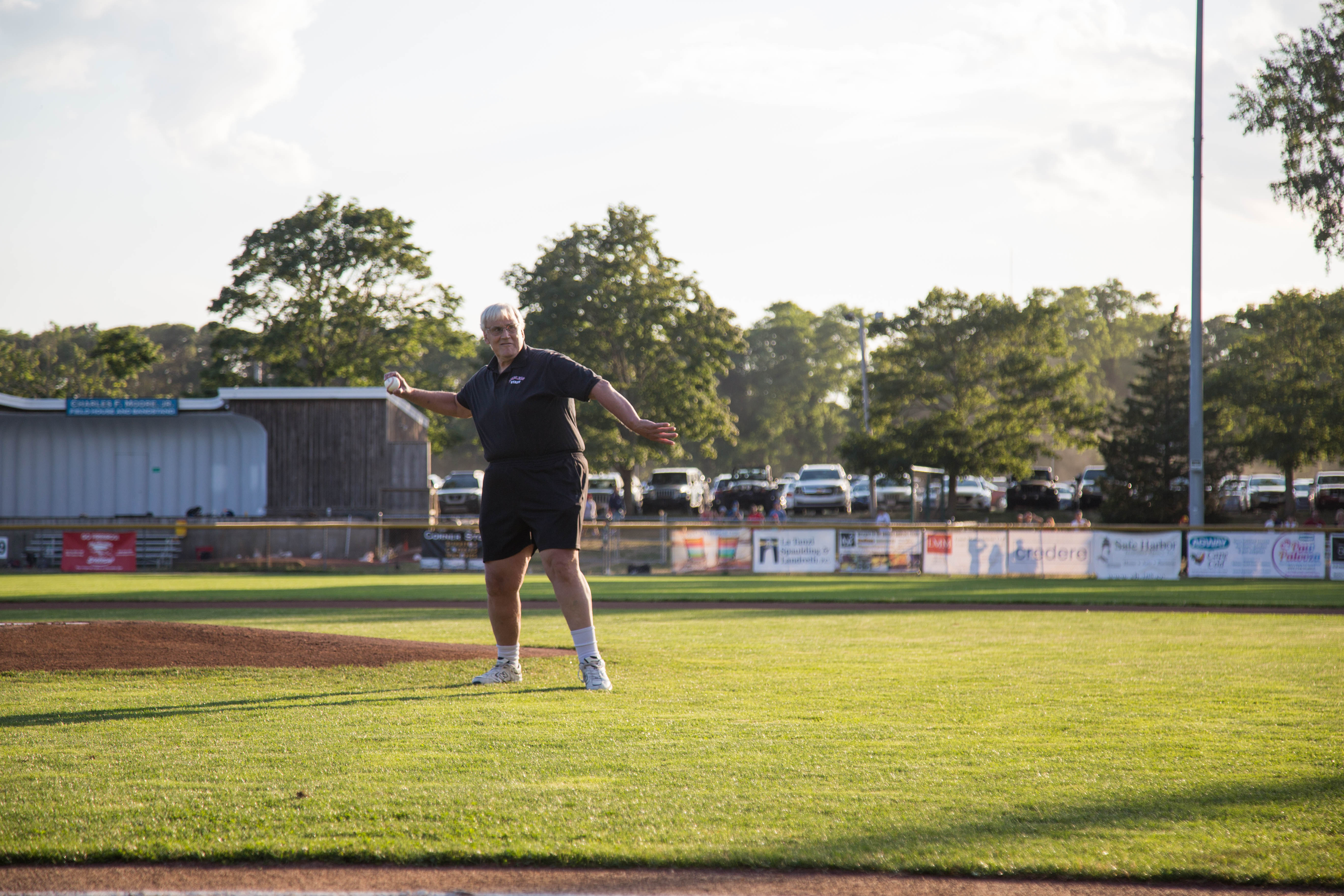
Ed Baird throws out the first pitch during Chatham's contest at Eldredge Park against Orleans on July 7, 2017. After his dominant career for Chatham, Baird earned a Cape League Hall of Fame induction. Chatham Anglers File Photo
As a general rule, the two lives that Ed has lived at Veterans Field rarely intertwine with each other. He doesn’t view himself as any more special than anyone else because of what he did in the 1960s, so he doesn’t carry himself as if he is. A vast majority of the customers he interacts with don’t know his past life, and that’s fine with him.
“He doesn’t like to be singled out,” CAA assistant general manager Stew Hesch said.
Hesch had no idea about Ed’s past when he met him. He didn’t find out until he visited Commerce Park, the warehouse where Ed stores Anglers merchandise. There’s a “mini Wall of Fame” hung up inside, with 8-by-10 inch papers featuring the names of Chatham’s CCBL Hall of Famers, and Hesch found out when he saw Ed’s name on it.
Once, Hesch recalls, he pulled out a No. 19 jersey to hang up in the merch booth to sell. It wasn’t selling, so he jokingly told Ed he was going to have him sign it, so it would be a Chatham pinstripe autographed by a Hall of Famer.
“Don’t be ridiculous,” Ed told him.
He’s humble, yes, but all rules have exceptions; this one is no exception. Burns made “Big Ed Baird” stickers some weeks ago, each one featuring an illustration of him in a fielding position, ready to make a play. A fan came up to the merchandise booth once, looking to get a few stickers. There’s a variety of options, all made by Burns, so the man wasn’t sure which to get.
“Get that one,” Ed told him, pointing to the one of himself.
The man bought the sticker.
Of all the exceptions to that rule, however, the biggest one came a few years ago. In the summer of 2021, his two lives converged, and it became impossible for Ed to hide the fact that he, the one who sells the merchandise and is the team’s treasurer, was once a legendary pitcher in Chatham.
That’s when Hesch and Geylin decided to retire Ed’s number.
Burns didn’t know it was going to happen. Hesch and Geylin wanted it to be a surprise. Burns saw Ed standing on the field, didn’t have a script to read, and asked Geylin what was going on.
Geylin said he’d handle it, so Burns watched. Directly below him, Streeter stood in the merchandise booth, calling over the younger volunteers who help Ed out every day. “Guys, come,” she beckoned. “Ed’s getting his number retired.” There was initial confusion before they came over and crowded one next to the other in the booth’s window facing the field, proud as ever as they cheered him on.
The following year, 2022, the Anglers held a ceremony to honor each of the men who had their number retired: Eddie Lyons (No. 29 in 2001), Matt Fincher (No. 23 in 2006), John Schiffner (No. 15 in 2017) and Ed’s No. 19. Baird spoke to the Veterans Field crowd and admitted having goosebumps, recalling the same goosebumps he had during his team’s 2005 reunion.
“He's so freaking happy in that video,” Burns said.
Because he cares. About a lot of things, really, but especially this team and these people. That’s why Ed takes each A’s loss like a diehard fan; “It'll be like the postgame show callers, like for the Mets,” Burns says, describing their conversations. Ed relies on the Anglers’ success, and conversely, the Anglers’ success relies on Ed. Occasionally, he’ll broach the topic of leaving to his daughter, Darcy, and his son, Bryce, but their response never changes.
What are you gonna do if you quit?
Just past his table, there’s a metal rack with a rapidly-thinning stack of cotton sweaters. A small American flag is stitched into them, along with the words CHATHAM ANGLERS. The sun’s gone, has been for a few innings now. The temperature is dropping. A fan eyes the sweaters. “Better get ‘em now,” Ed tells him, because they’re selling fast tonight, and this booth closes at the seventh inning stretch. Nothing lasts forever — these sweaters certainly don’t — and all anyone can really do is try to make everything last just a little bit longer.
So that’s what Ed does. He’ll order a new shipment soon.
“I like the selection this year,” a fan tells him.
“Good,” he says as he rings the man up for his shirt. “That’s what we like to hear.”
It’s June 16, Chatham’s second home game, and Ed Baird is back in the swing of things. This merchandise booth is finely tuned, supported by an ensemble of volunteers. Several of them are teenagers, just like Ed was when he first came to Chatham in 1965. He’s glad to be back.
“If it wasn't for the feelings that I have from having played here, and the friendships that I've developed over the years in the town itself,” Ed said, “I probably wouldn't have done this for as long as I'm doing it.”
But Chatham is home. That’s why “Big Ed” keeps making the annual pilgrimage from his residence in Connecticut to Veterans Field, conducting its merchandise booth with the same dominion he — as a Cape League Hall of Fame pitcher — once held over its mound. Things change on the Cape, more than they used to. Players come and go much faster than they used to, especially compared to the 1960s, when Ed was one of several returning players on 1967’s championship team.
And Ed’s still here, a bridge between two eras, as if nothing’s ever changed at all.
“Big Ed is the face of the organization,” Chatham Athletic Association president Steve West said June 27, in a speech addressing the organization at its annual Chatham Bars Inn luncheon.
“He really is Mr. Angler.”
Ed Baird, donning a blue Anglers' polo, sits behind rows of clothes in black boxes during a 2018 game at Veterans Field. Baird has been the A's treasurer and merchandise coordinator for over a decade. Photograph by Julia Hopkins
***
The Veterans Field press box sits behind rows of aluminum bleachers. The paint adorning its wooden 22-year-old exterior is a rich pine green. Four white disks resembling baseballs are bolted on the front of it. Each holds a name and a retired number. Three of them belong to longtime A’s coaches. Only one belongs to a player, and it reads:
19
Circling the number, in smaller blue print:
ED BAIRD
Each walk up the staircase inside the press box takes the same toll. The creak of wooden steps set the rhythm of one’s ascent. The light blue paint on each landing has been worn down by two decades of visits. Stories are told in this box, and these stairs tell a story themselves. This path has been laid out by all who came before.
Ed’s Chatham legacy can be split into two eras. The first is documented inside a black box atop this staircase. It holds a spiral-bound notebook, well over 100 pages thick, with each of the Cape Cod Times’ articles from the summer of 1967 — Chatham’s first championship season.
“That's the way it was back then,” Ed said. “The paper was full of stories about every Cape League game from the day before."
The parents of Gary Lautzenhiser, Chatham’s first baseman in 1967, preserved all of the Times’ newspapers from that summer. Ahead of the team’s 2005 reunion, Lautzenhiser sent them to Ed, who photocopied the stories into this yearbook commemorating their season. Ed says it's a priceless recap of that championship summer.
In its totality, the book is a physical record of Ed’s dominance. “Chatham Wins, 7-0, On Baird’s 2-Hitter,” reads a headline from June 28, 1967. “Baird Pitches One-Hitter In Darkness-Halted Tilt,” says another clipping from July 14. “Ed Baird Shuts Out Cardinals for 1-0 Lead,” reads a third story from August 27, a playoff game against Orleans.
And that’s how Ed concluded his dominant three-summer run in Chatham, leaving the Cape with a 1.89 earned run average. It took him some convincing to even get there. George Greer — who played with Ed at UConn — called him at least four times trying to get him to join the A’s, and Ed’s own hesitation due to a knee injury sustained during his freshman year at UConn, was the only force that could stop him.
“You have to talk Ed into doing something, and you can't take no for an answer,” Greer said. “And once he does it, then he loves it.”
He loved a lot of things, comedy being one of them. Ed often told self-deprecating jokes, most of which have been lost to the sands of time. He hated running, so when Chatham manager Joe “Skip” Lewis had pitchers run sprints, Ed made guys laugh by sticking his head under a hose to make it look like sweat. Lewis asked him if he did his sprints, to which Ed said yes.
“If you did any running at all,” Lewis once replied, “then I'm a Japanese aviator.”
But Ed wasn’t nearly as funny on the mound. “He was an imposing figure,” said Bobby Valentine, the former New York Mets manager who played for Yarmouth in 1967. There’s a portion of Valentine’s memoir, “Valentine’s Way: My Adventurous Life and Times,” where he recalls a matchup against Ed. He stood close to the plate as Ed warmed up, trying to time his rhythm, while A’s catcher Thurman Munson tried to warn him against it.
“Thurman told me not to do that,” Valentine recalled in a recent phone interview. “It probably wasn't good for my future.”
It wasn’t because Valentine was a high schooler at the time. With how hard Ed was throwing, it just wouldn’t have been a good idea for any hitter’s future, frankly.
In that 1967 season, he pitched four shutouts en route to Chatham's championship. He led the Cape with 70 strikeouts the summer before that, and held batters to just 4.05 hits per nine innings in 1965. Ed never won the BFC Whitehouse Pitcher of the Year Award — it twice went to his teammate, Joe Jabar — but Jabar still believes they should’ve shared it.
Yet many fans who visit Veterans Field may never make the connection between the retired number adorning one side of the press box, and the man sitting around the corner who wore it.
“You wouldn't know that he was a storied pitcher for UConn in his youth. Or had three terrific seasons in Chatham, and he was arguably the best pitcher in the league when he played here,” Anglers general manager Mike Geylin said. “Things like that, you would never get that from Ed.”
He’s modest and doesn’t feel the need to harp on his playing career, because that was all a past life. Ed leads a different one now, as does everyone from those years. Greer served as Wake Forest’s head coach for almost two decades. Jabar went to law school at the University of Maine, and became a justice in the Maine Supreme Court.
But there’s something special about Chatham. It exerts a magnetism on those who visit. Year after year, the same people come back at the same times, doing the same things all over again. “The Chatham Experience,” as former A’s manager John Schiffner calls it.
Before the team’s 2005 reunion, Ed penned a preface for his yearbook. It ends with a message to his teammates:
“I am anxiously awaiting the weekend of July 23, 2005, when most of us will return to Veterans Field to celebrate and get reacquainted,” it reads. “However, this year, when we all once again go our separate ways, let's make sure we find the time to stay connected.”
The members of Chatham's 1967 championship-winning team pose for a team photo during their reunion in July 2005. Baird helped organize the reunion with the help of his teammates. Chatham Anglers File Photo
***
The second era of Ed’s time in Chatham lies directly below that spiral-bound book. One important chapter of his life was written at Veterans Field, and this one is, too. There were a couple years of pro ball and a couple decades of accounting between the two, but Ed can’t stay away. It’s been that way forever.
“Back then, when the season was over, we didn't want to go home,” Ed said. “Chatham is a great place to spend time.”
It’s why the vast majority of his summers are spent here, manning this register in the merchandise booth directly below the Veterans Field press box. This is the branding boom that he and Debbie Kavey bolstered. Geylin couldn’t even fathom the financial benefits the CAA, a non-profit organization, has reaped from this operation.
“I know the numbers of what we sell in five hours, four-and-a-half hours,” Geylin said. “I also know that no store in town is doing that.”
Years before Ed arrived, merchandise was run by Diane Troy, the wife of former Chatham Athletic Association president Peter Troy. Back then, West says, it was a “very well-run operation.”
But after the Troys moved on, the organization experienced a period of instability. The CAA went through “two or three presidents,” per West, and merchandise sales stagnated.
“Having a stable dynamic has been very, very helpful,” West said. “But that was not the organization that Ed and I entered.”
Years before, Schiffner met Ed at a UConn football tailgate hosted by Greer. The two hit it off. So well, in fact, that at some point in the early 2000s, Ed began visiting the Cape in the summers. He stayed at Schiffner’s Harwich residence whenever he came to town.
That routine continued for years. In 2011, the CAA was looking for a treasurer. Schiffner, knowing Ed’s accounting background and love for Chatham made him a perfect fit, asked if he wanted to take the role. Ed didn’t think it made sense for the team treasurer not to live in Chatham, but Schiffner offered up his home for him.
Ed relented and initially became interim treasurer. Shortly after, the CAA asked if he was willing to run merchandise as well. He didn’t have a modicum of merchandising experience, but they said there was a woman who could help him. She’d done similar stuff for her son’s youth hockey team.
Her name was Debbie Kavey.
From there, a partnership was born. Their responsibilities weren’t set in stone, but certain things were always delegated certain ways. Debbie dealt with vendors in Massachusetts, Ed handled those in Westchester, New York. Ed loved hats and athletic gear, while Debbie loved more beachy, relaxed designs — what they called “resort wear.”
“It could be found downtown, it could be found at the baseball game, but it says Chatham Anglers,” her son, Jack, said. “She loved those designs.”
The bond between Ed and Debbie soon became a familial one — “You are part of our family,” her sister, Kathy Olsen, would tell him — so naturally, the booth became a family affair. Jack soon followed in his mother’s footsteps, first by folding clothes as a child, then by showing up to merchandise meetings at 15, and then by coming up with designs for clothes.
Ideas came from everywhere. Ed searched athletic websites and watched sports year-round, and jotted down ideas he liked from the designs he saw on the internet and TV. Jack, who eventually attended Providence College, drew inspiration from what he saw his peers wearing on campus or downtown. Debbie would take pictures of everything, from Vineyard Vines shirts to college bookstore apparel.
It was a well-oiled machine, right up until the winter before the COVID-19 pandemic, when Debbie lost her bout with esophageal cancer.
“He and I were (going to) lunch, and he called me up,” Anglers’ public address announcer Peter Burns recalled. “And he said, ‘I know you think I'm calling you for lunch, but Debbie passed away.’”
Jack was crushed. “There was definitely a part of me that was like, ‘Oh, I don't wanna be at that field,’” Jack says, but he eventually reframed the role. The booth wasn’t a reminder of his mother’s passing, but a chance to continue her legacy.
That’s how Debbie’s other sister, Joan Streeter, viewed it, too. Streeter knew she couldn’t fill Debbie’s shoes. Debbie was so integral to the operation that Ed nicknamed her “Mama Merch.” But Streeter felt she owed it to her sister’s legacy to try to keep it going.
“Debbie and Ed had built such a fantastic stand,” Streeter said. “I just wanted to be part of it.”
Thus, the booth looks both different and the same now. Jack’s not around anymore, having graduated from Providence, and his brother R.J. has taken his place, folding new shirts and putting them into old black boxes. Streeter’s here in her sister’s place, but Debbie’s stamp is still left in the booth’s three-table U-shaped formation, which she created herself.
And Ed is still parked at the register. His products are still flying off the shelves.
Every year, Geylin says, the board members joke amongst themselves if this is the year that the proverbial bubble bursts, and their merchandise sales drop back down to earth. Every year, without fail, the answer is an emphatic no. It’ll remain that way as long as Ed’s there.
“This is Chatham,” Ed jokes, sitting at his register. “People enjoy our merchandise, and don't think twice about spending year after year.”
Ed Baird throws out the first pitch during Chatham's contest at Eldredge Park against Orleans on July 7, 2017. After his dominant career for Chatham, Baird earned a Cape League Hall of Fame induction. Chatham Anglers File Photo
***
As a general rule, the two lives that Ed has lived at Veterans Field rarely intertwine with each other. He doesn’t view himself as any more special than anyone else because of what he did in the 1960s, so he doesn’t carry himself as if he is. A vast majority of the customers he interacts with don’t know his past life, and that’s fine with him.
“He doesn’t like to be singled out,” CAA assistant general manager Stew Hesch said.
Hesch had no idea about Ed’s past when he met him. He didn’t find out until he visited Commerce Park, the warehouse where Ed stores Anglers merchandise. There’s a “mini Wall of Fame” hung up inside, with 8-by-10 inch papers featuring the names of Chatham’s CCBL Hall of Famers, and Hesch found out when he saw Ed’s name on it.
Once, Hesch recalls, he pulled out a No. 19 jersey to hang up in the merch booth to sell. It wasn’t selling, so he jokingly told Ed he was going to have him sign it, so it would be a Chatham pinstripe autographed by a Hall of Famer.
“Don’t be ridiculous,” Ed told him.
He’s humble, yes, but all rules have exceptions; this one is no exception. Burns made “Big Ed Baird” stickers some weeks ago, each one featuring an illustration of him in a fielding position, ready to make a play. A fan came up to the merchandise booth once, looking to get a few stickers. There’s a variety of options, all made by Burns, so the man wasn’t sure which to get.
“Get that one,” Ed told him, pointing to the one of himself.
The man bought the sticker.
Of all the exceptions to that rule, however, the biggest one came a few years ago. In the summer of 2021, his two lives converged, and it became impossible for Ed to hide the fact that he, the one who sells the merchandise and is the team’s treasurer, was once a legendary pitcher in Chatham.
That’s when Hesch and Geylin decided to retire Ed’s number.
Burns didn’t know it was going to happen. Hesch and Geylin wanted it to be a surprise. Burns saw Ed standing on the field, didn’t have a script to read, and asked Geylin what was going on.
Geylin said he’d handle it, so Burns watched. Directly below him, Streeter stood in the merchandise booth, calling over the younger volunteers who help Ed out every day. “Guys, come,” she beckoned. “Ed’s getting his number retired.” There was initial confusion before they came over and crowded one next to the other in the booth’s window facing the field, proud as ever as they cheered him on.
The following year, 2022, the Anglers held a ceremony to honor each of the men who had their number retired: Eddie Lyons (No. 29 in 2001), Matt Fincher (No. 23 in 2006), John Schiffner (No. 15 in 2017) and Ed’s No. 19. Baird spoke to the Veterans Field crowd and admitted having goosebumps, recalling the same goosebumps he had during his team’s 2005 reunion.
“He's so freaking happy in that video,” Burns said.
Because he cares. About a lot of things, really, but especially this team and these people. That’s why Ed takes each A’s loss like a diehard fan; “It'll be like the postgame show callers, like for the Mets,” Burns says, describing their conversations. Ed relies on the Anglers’ success, and conversely, the Anglers’ success relies on Ed. Occasionally, he’ll broach the topic of leaving to his daughter, Darcy, and his son, Bryce, but their response never changes.
What are you gonna do if you quit?
Just past his table, there’s a metal rack with a rapidly-thinning stack of cotton sweaters. A small American flag is stitched into them, along with the words CHATHAM ANGLERS. The sun’s gone, has been for a few innings now. The temperature is dropping. A fan eyes the sweaters. “Better get ‘em now,” Ed tells him, because they’re selling fast tonight, and this booth closes at the seventh inning stretch. Nothing lasts forever — these sweaters certainly don’t — and all anyone can really do is try to make everything last just a little bit longer.
So that’s what Ed does. He’ll order a new shipment soon.