Anglers News« Back to 2026 News |
LSU’s Bino Watters wants to take over the SEC. Chatham was Step 1.

SOUTH YARMOUTH, Mass. — The question is asked, and a hearty laugh escapes Jay Johnson’s mouth, as if he’d been waiting to tell this story for a while. Yes, of course he remembers the moment Bino Watters committed.
Back in early June, the LSU head coach was set to do a television interview with Michael Cauble, the sports director at WBRZ-TV, Baton Rouge, Louisiana’s ABC affiliate. For a little over a week, he had been courting Watters, the nation’s No. 1 transfer, as aggressively as one should court the nation’s No. 1 transfer. His decision was imminent, and LSU was one of his finalists, so Johnson gave Cauble a warning.
He told Cauble he was waiting for a phone call, and if it came, he’d have to depart. Thus, the two began the interview with the cloud of Bino Watters’ commitment hanging over them, knowing Johnson’s disposition was at the mercy of a 20-year-old, as college coaches’ dispositions always are. A little over five minutes into the conversation, Johnson received the call, and apologized before jetting out of the room.
We got him.
“I was very excited,” Johnson says.
He had every reason to be. Anyone who’s seen Watters, whether at Notre Dame these past two springs or this summer in Chatham, has witnessed the caliber of hitter he is. “The natural talent was easy to see,” Johnson says. Last spring with the Fighting Irish, he hit .362 with a 1.057 OPS across 218 at bats. This summer in Chatham, he finished the regular season leading all qualified Anglers with a .318 batting average, a .788 OPS, 29 runs batted in and 132 at-bats.
Watters has raked everywhere he’s gone, but baseball’s a different animal in the Southeastern Conference. Its marketing slogan reads: It Just Means More. By going to LSU, Watters is jumping headfirst into a program that’s won two of the last four national championships, in a conference that’s won eight of the last nine, and taking on all the extra attention and scrutiny that might come with it. But it doesn’t faze him.
“I think the LSU fanbase is gonna like us a lot,” Watters says.
Because, before he declares for the 2027 MLB Draft, Watters has a plan to take over the SEC. His first step was Chatham, where he capped off his All-Star summer by winning the team’s Thurman Munson Most Outstanding Position Player award. With the A’s Thursday loss to Y-D, Watters’ time in Chatham has come to a close, but his story is just beginning, and Jay Powell thinks he’s seen this one before. The A’s pitching coach already knows how it ends.
He watched on as Daniel Jackson, the Georgia catcher who was Chatham’s Thurman Munson Award winner last summer, led the A’s with an .818 OPS. Then Powell — a Mississippi State alum — watched on, albeit slightly begrudgingly, as that same Munson Award winner took over the college baseball world this past spring by claiming the Golden Spikes Award and the Dick Howser Trophy.
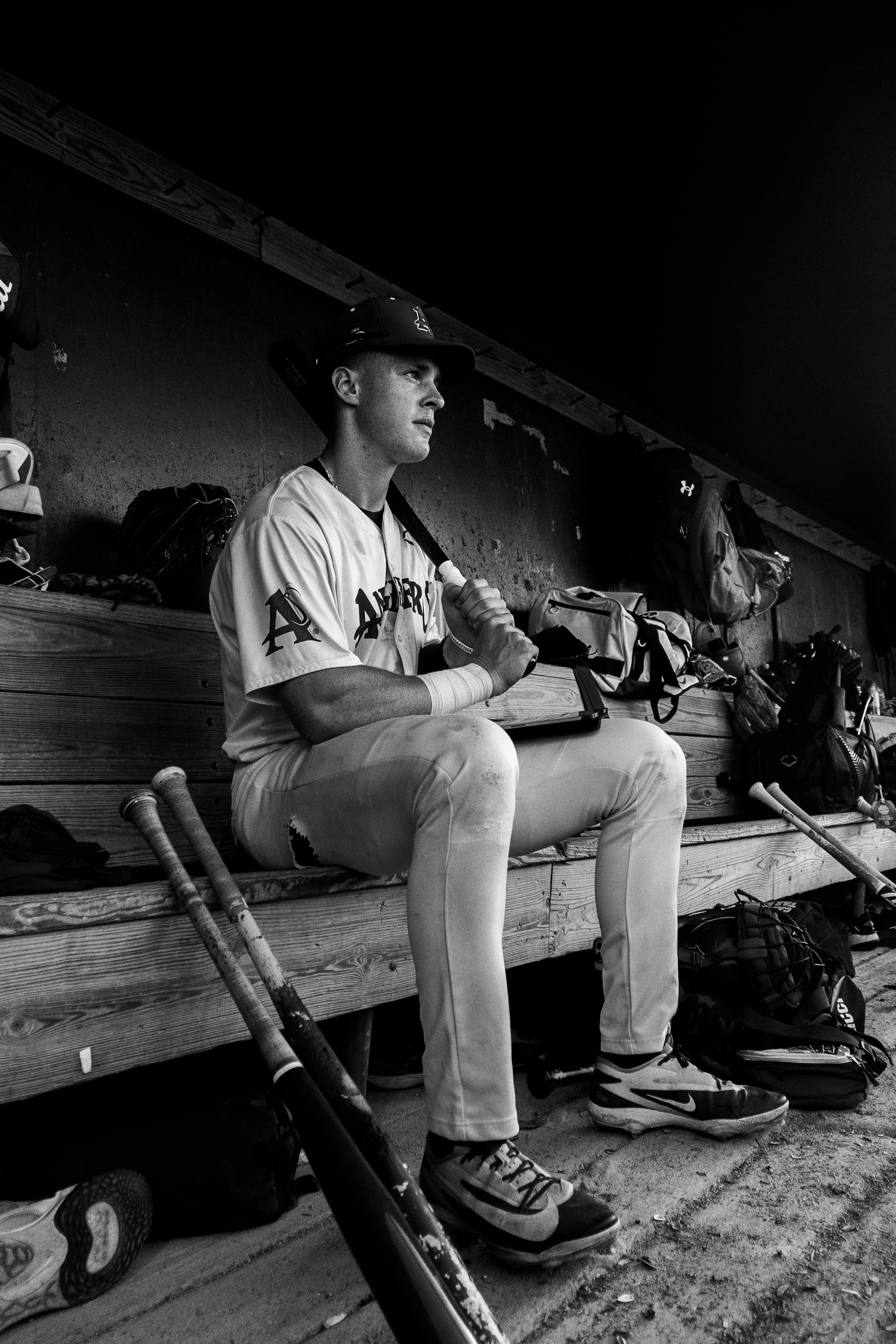
Bino Watters holds a bat in Chatham's dugout before the A's 1-0 loss to Yarmouth-Dennis in the East Divisional Series. Watters took home Chatham's Thurman Munson Award for his offensive performance. Photograph by Alistair Hennessey
You see where this is going now, don’t you?
“I look at what Daniel Jackson did up here last year, and how I really think it translated into what he did with Georgia,” Powell said on Aug. 2, following Watters’ two-double, four-RBI performance against Y-D. “And I think he's gonna be the same type of player.”
Powell’s far from the first person to heap mountains of praise on Watters. Once, back in the eighth grade, Watters was told he was too small to play up a year with his travel team, as he had been doing all his life. That’s probably the final time anyone has ever underestimated him.
“(He’s) like, ‘No one's gonna tell me I'm not big enough and strong enough,’” says his mother, Tammi. “‘I'm gonna prove everybody wrong.’”
Watters has been doing that ever since. He hit a growth spurt after the COVID-19 pandemic, and got on Notre Dame’s radar as a junior in high school after attending a showcase in Atlanta. He stepped into Notre Dame’s lineup right away in his freshman year, after a fall ball period where he says he went “unconscious” and hit about .560.
Then, he had a .984 OPS as a member of ND’s starting outfield that season, and only built on that performance in Year 2. “After you play in the ACC,” Watters says, “you feel like you can go do it again the next year.” That led to his aforementioned 2026 campaign, where he made an immediate impression on Johnson when the Tigers played against Notre Dame in nonconference play.
“He was kind of the targeted guy in that lineup that we didn't wanna let beat us,” Johnson says.
So, when Watters entered the transfer portal, Johnson was immediately on high alert. Coming off a 30-28 campaign, Johnson had lost his entire starting outfield. The crown jewel, Derek Curiel, went No. 5 overall by the Pittsburgh Pirates in the 2026 MLB Draft.
Johnson has won two national championships in his five years at the helm of LSU’s program, and both times, he says, that success was precipitated by impact transfers. The first one, back in 2023, was a product of Paul Skenes’ transfer from Air Force and Tommy White’s transfer from NC State. The second, back in 2025, was a product of Danny Dickinson’s move from Utah Valley and Anthony Eyanson’s jump from UC San Diego.
While most coaches dream of one title, Johnson wants to get back to a third, and he’s convinced Watters has the skillset to help him do it.
“There's always a player that tips the scales to where you can have the possibility of having the type of team that you want,” Johnson said. “And I believe Bino fits in that mold.”
Watters wanted to win, too. That’s why he left Notre Dame in the first place. The Fighting Irish were a solid team, finishing 31-22 in 2026, and he’d played alongside high-end talents like 2026 second-round pick Carson Tinney and future first-round righty Jack Radel in his two years there. But he felt like he had to look elsewhere to elevate his game.
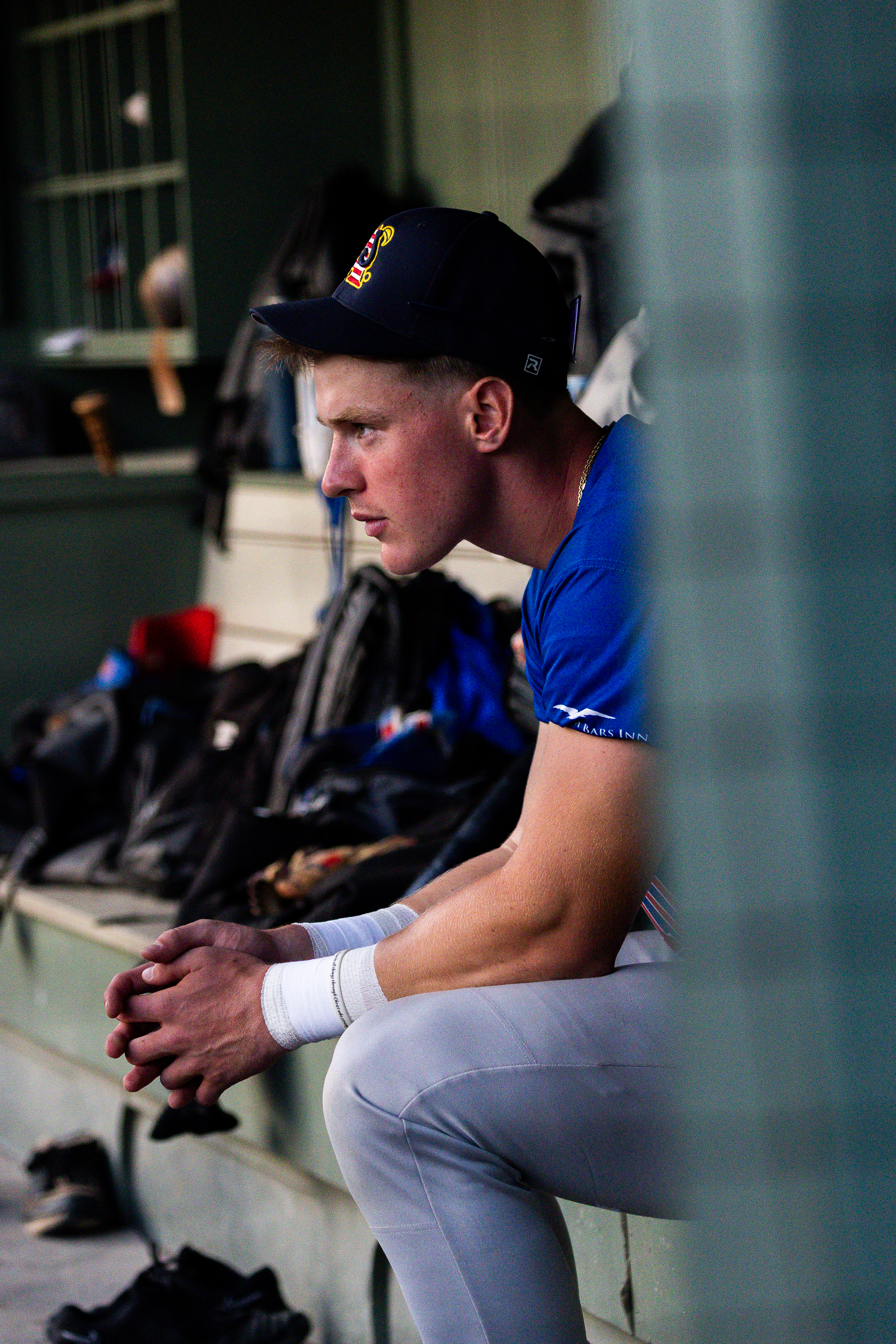
Bino Watters sits in Chatham's dugout during its 9-0 win over Brewster on July 31. Watters played more than any Angler, leading the team with 35 games and 132 at bats this summer. Photograph by Alistair Hennessey
Johnson just had to convince him that he could accomplish that at LSU. Originally, Tammi says, the Tigers were a third choice for Watters. He pictured himself at Texas, like Tinney, or Texas A&M. They weren’t inundated with calls, since he entered with a “do-not-contact” tag. Watters had a select few schools he was considering, and LSU wasn’t atop that list at first.
“I thought I was going to go to A&M or Texas, out of the three,” Watters says.
But everything changed once he visited LSU. Tammi said she was blown away by the professionalism of the visit. “It just made him feel like the red carpet was seriously rolled out for him,” she says. Watters said they took him through a simulated day on campus, and showed him a 10-month “business plan,” laying out the things they intended to do to win a national championship while molding Watters into a high-end pro prospect.
He was sold. Watters, after agonizing about the decision, eventually decided LSU was the spot for him. He informed his family via text, and the topic was never broached again afterward.
It never needed to be, because they understood it was the right decision. Johnson came to visit Watters in Chatham midway through his torrid debut season on the Cape, and he already noticed some places where he could fine-tune Watters’ approach. When it comes to putting players in a position to go to the majors, few coaches have a better track record than Johnson.
“They've developed some of the best hitters to ever come out of college baseball,” Watters said, referring to Johnson and his staff. “So, they have a pretty good clue what they're doing.”
One aspect, in particular, was pitch selection. “Trying to get those heat maps to line up, and make sure that the pitches I do swing at, I'm putting good swings on,” Watters says. Johnson was already impressed with Watters’ plate discipline, but Watters said they noticed he was leaving production on the table by swinging at pitches he doesn’t tend to do damage on.
In Chatham, he tried to get a head start on some of those changes. He appreciated playing every day for the A’s, and that opportunity gave him the freedom to try things out. He wants to be the best player possible heading into the spring, so he can lead LSU to that national championship that both he — and Johnson — want so badly.
But he stopped worrying as much about pitch selection as the summer went on. Those adjustments can wait for LSU. “I realized I was thinking a little too much, so I just kind of dropped that,” Watters says. The old adage goes, “If it ain’t broke, don’t fix it.”
Sounds about right. Watters has a Thurman Munson Award to prove it.
Back in early June, the LSU head coach was set to do a television interview with Michael Cauble, the sports director at WBRZ-TV, Baton Rouge, Louisiana’s ABC affiliate. For a little over a week, he had been courting Watters, the nation’s No. 1 transfer, as aggressively as one should court the nation’s No. 1 transfer. His decision was imminent, and LSU was one of his finalists, so Johnson gave Cauble a warning.
He told Cauble he was waiting for a phone call, and if it came, he’d have to depart. Thus, the two began the interview with the cloud of Bino Watters’ commitment hanging over them, knowing Johnson’s disposition was at the mercy of a 20-year-old, as college coaches’ dispositions always are. A little over five minutes into the conversation, Johnson received the call, and apologized before jetting out of the room.
We got him.
“I was very excited,” Johnson says.
He had every reason to be. Anyone who’s seen Watters, whether at Notre Dame these past two springs or this summer in Chatham, has witnessed the caliber of hitter he is. “The natural talent was easy to see,” Johnson says. Last spring with the Fighting Irish, he hit .362 with a 1.057 OPS across 218 at bats. This summer in Chatham, he finished the regular season leading all qualified Anglers with a .318 batting average, a .788 OPS, 29 runs batted in and 132 at-bats.
Watters has raked everywhere he’s gone, but baseball’s a different animal in the Southeastern Conference. Its marketing slogan reads: It Just Means More. By going to LSU, Watters is jumping headfirst into a program that’s won two of the last four national championships, in a conference that’s won eight of the last nine, and taking on all the extra attention and scrutiny that might come with it. But it doesn’t faze him.
“I think the LSU fanbase is gonna like us a lot,” Watters says.
Because, before he declares for the 2027 MLB Draft, Watters has a plan to take over the SEC. His first step was Chatham, where he capped off his All-Star summer by winning the team’s Thurman Munson Most Outstanding Position Player award. With the A’s Thursday loss to Y-D, Watters’ time in Chatham has come to a close, but his story is just beginning, and Jay Powell thinks he’s seen this one before. The A’s pitching coach already knows how it ends.
He watched on as Daniel Jackson, the Georgia catcher who was Chatham’s Thurman Munson Award winner last summer, led the A’s with an .818 OPS. Then Powell — a Mississippi State alum — watched on, albeit slightly begrudgingly, as that same Munson Award winner took over the college baseball world this past spring by claiming the Golden Spikes Award and the Dick Howser Trophy.
Bino Watters holds a bat in Chatham's dugout before the A's 1-0 loss to Yarmouth-Dennis in the East Divisional Series. Watters took home Chatham's Thurman Munson Award for his offensive performance. Photograph by Alistair Hennessey
You see where this is going now, don’t you?
“I look at what Daniel Jackson did up here last year, and how I really think it translated into what he did with Georgia,” Powell said on Aug. 2, following Watters’ two-double, four-RBI performance against Y-D. “And I think he's gonna be the same type of player.”
Powell’s far from the first person to heap mountains of praise on Watters. Once, back in the eighth grade, Watters was told he was too small to play up a year with his travel team, as he had been doing all his life. That’s probably the final time anyone has ever underestimated him.
“(He’s) like, ‘No one's gonna tell me I'm not big enough and strong enough,’” says his mother, Tammi. “‘I'm gonna prove everybody wrong.’”
Watters has been doing that ever since. He hit a growth spurt after the COVID-19 pandemic, and got on Notre Dame’s radar as a junior in high school after attending a showcase in Atlanta. He stepped into Notre Dame’s lineup right away in his freshman year, after a fall ball period where he says he went “unconscious” and hit about .560.
Then, he had a .984 OPS as a member of ND’s starting outfield that season, and only built on that performance in Year 2. “After you play in the ACC,” Watters says, “you feel like you can go do it again the next year.” That led to his aforementioned 2026 campaign, where he made an immediate impression on Johnson when the Tigers played against Notre Dame in nonconference play.
“He was kind of the targeted guy in that lineup that we didn't wanna let beat us,” Johnson says.
So, when Watters entered the transfer portal, Johnson was immediately on high alert. Coming off a 30-28 campaign, Johnson had lost his entire starting outfield. The crown jewel, Derek Curiel, went No. 5 overall by the Pittsburgh Pirates in the 2026 MLB Draft.
Johnson has won two national championships in his five years at the helm of LSU’s program, and both times, he says, that success was precipitated by impact transfers. The first one, back in 2023, was a product of Paul Skenes’ transfer from Air Force and Tommy White’s transfer from NC State. The second, back in 2025, was a product of Danny Dickinson’s move from Utah Valley and Anthony Eyanson’s jump from UC San Diego.
While most coaches dream of one title, Johnson wants to get back to a third, and he’s convinced Watters has the skillset to help him do it.
“There's always a player that tips the scales to where you can have the possibility of having the type of team that you want,” Johnson said. “And I believe Bino fits in that mold.”
Watters wanted to win, too. That’s why he left Notre Dame in the first place. The Fighting Irish were a solid team, finishing 31-22 in 2026, and he’d played alongside high-end talents like 2026 second-round pick Carson Tinney and future first-round righty Jack Radel in his two years there. But he felt like he had to look elsewhere to elevate his game.
Bino Watters sits in Chatham's dugout during its 9-0 win over Brewster on July 31. Watters played more than any Angler, leading the team with 35 games and 132 at bats this summer. Photograph by Alistair Hennessey
Johnson just had to convince him that he could accomplish that at LSU. Originally, Tammi says, the Tigers were a third choice for Watters. He pictured himself at Texas, like Tinney, or Texas A&M. They weren’t inundated with calls, since he entered with a “do-not-contact” tag. Watters had a select few schools he was considering, and LSU wasn’t atop that list at first.
“I thought I was going to go to A&M or Texas, out of the three,” Watters says.
But everything changed once he visited LSU. Tammi said she was blown away by the professionalism of the visit. “It just made him feel like the red carpet was seriously rolled out for him,” she says. Watters said they took him through a simulated day on campus, and showed him a 10-month “business plan,” laying out the things they intended to do to win a national championship while molding Watters into a high-end pro prospect.
He was sold. Watters, after agonizing about the decision, eventually decided LSU was the spot for him. He informed his family via text, and the topic was never broached again afterward.
It never needed to be, because they understood it was the right decision. Johnson came to visit Watters in Chatham midway through his torrid debut season on the Cape, and he already noticed some places where he could fine-tune Watters’ approach. When it comes to putting players in a position to go to the majors, few coaches have a better track record than Johnson.
“They've developed some of the best hitters to ever come out of college baseball,” Watters said, referring to Johnson and his staff. “So, they have a pretty good clue what they're doing.”
One aspect, in particular, was pitch selection. “Trying to get those heat maps to line up, and make sure that the pitches I do swing at, I'm putting good swings on,” Watters says. Johnson was already impressed with Watters’ plate discipline, but Watters said they noticed he was leaving production on the table by swinging at pitches he doesn’t tend to do damage on.
In Chatham, he tried to get a head start on some of those changes. He appreciated playing every day for the A’s, and that opportunity gave him the freedom to try things out. He wants to be the best player possible heading into the spring, so he can lead LSU to that national championship that both he — and Johnson — want so badly.
But he stopped worrying as much about pitch selection as the summer went on. Those adjustments can wait for LSU. “I realized I was thinking a little too much, so I just kind of dropped that,” Watters says. The old adage goes, “If it ain’t broke, don’t fix it.”
Sounds about right. Watters has a Thurman Munson Award to prove it.